Control Systems Section 2

Block Diagram Reduction

A visual and algebraic methodology used to simplify complex, multi-component interconnected systems into a single overall Transfer Function.

1. What is exactly a Block Diagram?

A block diagram is simply a graphical representation consisting of a group of blocks that represent different parts of a system, and signal lines that define the mathematical relationship between these blocks.

Example: Inverting Amplifier

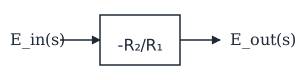
An input voltage $E_{in}$ enters the system. The transfer function of the inverting amplifier is $-R_2/R_1$. The output is $E_{out}$.

Inverting Amplifier Block Diagram

Example: Kinematic System

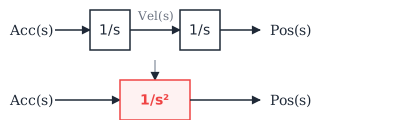
Acceleration is integrated ($1/s$) to get velocity, which is integrated again to get position. These blocks can be reduced into one overall function.

Kinematic System Reduction

This conversion from multiple blocks to a single block is exactly what we call Reduction. It gives the direct relation between the input and the final output without any intermediate issues.

2. Block Diagram Reduction Rules (Algebra)

A block diagram reduction helps us get a system's overall transfer function. To do this safely, we rely on a set of mathematical rules that preserve the integrity of the signals. Here is the complete reference table of the 6 fundamental rules:

Manipulation Original Block Diagram Equivalent Block Diagram Equation
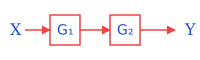
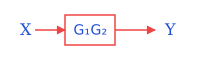
1. Combining Blocks in Cascade Rule 1 Original Rule 1 Equivalent $$Y = (G_1 G_2)X$$
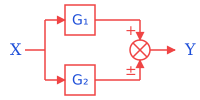
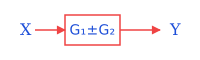
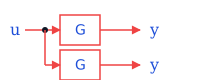
2. Combining Blocks in Parallel; or Eliminating a Forward Loop Rule 2 Original Rule 2 Equivalent $$Y = (G_1 \pm G_2)X$$
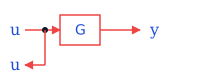
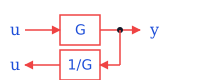
3. Moving a pickoff point behind a block Rule 3 Original Rule 3 Equivalent
$$y = G u$$
$$u = \frac{1}{G} y$$
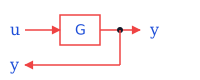
4. Moving a pickoff point ahead of a block Rule 4 Original Rule 4 Equivalent $$y = G u$$
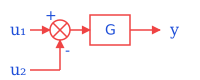
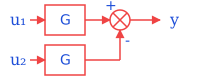
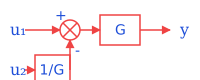
5. Moving a summing point behind a block Rule 5 Original Rule 5 Equivalent $$e_2 = G(u_1 - u_2)$$
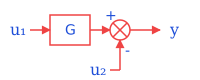
6. Moving a summing point ahead of a block Rule 6 Original Rule 6 Equivalent $$y = G u_1 - u_2$$

3. Feedback Loop Connection (Crucial)

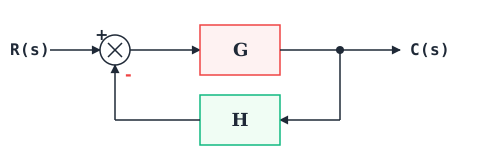
This is the most important structure you will find across the entire control systems course: the Closed-Loop Feedback system. It allows the controller to minimize the error by feeding the output back into the input.

Standard Negative Feedback Loop

Standard Negative Feedback Loop

Mathematical Derivation

Let's convert this entire closed-loop system into one single transfer function. We want to find the relation $\frac{C(S)}{R(S)}$.

  1. The output $C(S)$ is the error $E(S)$ multiplied by the forward gain $G$:
    $$C(S) = E(S) \cdot G$$
  2. For a Negative Feedback loop, the error $E(S)$ is the reference minus the feedback signal:
    $$E(S) = R(S) - C(S)H$$
  3. Substitute $E(S)$ into the first equation:
    $$C(S) = [R(S) - C(S)H] \cdot G$$
    $$C(S) = R(S)G - C(S)HG$$
  4. Take $C(S)$ to the other side to group them:
    $$C(S) + C(S)HG = R(S)G$$
    $$C(S)[1 + GH] = R(S)G$$
  5. Isolate the Transfer Function:
    $$\frac{C(S)}{R(S)} = \frac{G}{1 + GH}$$

What about Positive Feedback?

If the feedback signal is added at the summing node instead of subtracted, the sign inside the brackets reverses. The resulting Transfer Function for a positive feedback loop becomes: $\frac{G}{1 - GH}$.

4. Solved Examples

Example 1: DC Motor System Modeling

To truly understand reduction, let's look at a physical mechatronic system: a DC Motor. A DC motor takes an input electrical voltage $E_a$ and outputs a mechanical rotational speed $\omega_m$. It perfectly bridges electrical and mechanical physics.

1. The Physical System

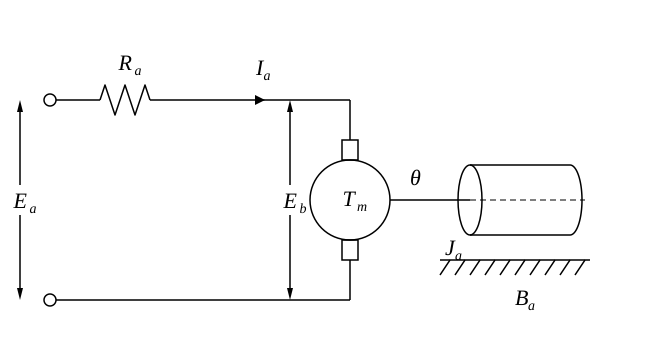
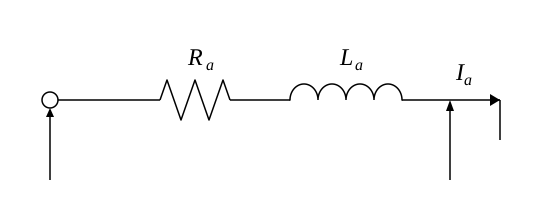
Here is the physical schematic of the armature-controlled DC motor. It consists of an electrical circuit (the armature) driving a mechanical rotational load.

DC Motor Physical Circuit

2. Deriving the Equations (Time to S-Domain)

To create our block diagram, we must break down the physical schematic into fundamental equations using Kirchhoff's and Newton's laws, and then transform them into the Laplace domain. In this specific example, let's assume the parameters are $R_a = 0.4 \Omega$, Motor Torque constant $K_\phi = 2$, Inertia $J = 12$, and Viscous friction $\beta = 10$. The Back-EMF constant is also $K_\phi = 2$.

A. The Electrical Armature Circuit

Applying Kirchhoff's Voltage Law (KVL) to the armature loop in the time domain:

$$E_a(t) - E_b(t) = R_a I_a(t) + L_a \frac{dI_a(t)}{dt}$$

Applying the Laplace transform to isolate the current $I_a(s)$. (Note: in steady state, $L_a \approx 0$ is neglected) :

$$I_a(s) = \frac{E_a(s) - E_b(s)}{R_a} = \frac{E_a(s) - E_b(s)}{0.4}$$
B. Electromechanical Conversion

The mechanical torque $T_m$ produced by the motor is directly proportional to the armature current, dictated by the motor constant $K_\phi$.

$$T_m(t) = K_\phi \cdot I_a(t)$$
$$T_m(s) = 2 \cdot I_a(s)$$
C. Mechanical Load Dynamics

According to Newton's Second Law ($\sum T = J\alpha$), the net torque equals Inertia $J$ times angular acceleration, plus viscous friction. Assuming no external load ($T_L = 0$):

$$T_m(t) = J \frac{d\omega_m(t)}{dt} + \beta \omega_m(t)$$

Applying Laplace to isolate the speed $\omega_m(s)$:

$$T_m(s) = (Js + \beta)\omega_m(s) \implies \omega_m(s) = T_m(s) \cdot \frac{1}{12S + 10}$$
D. The Built-in Negative Feedback (Back-EMF)

The spinning motor generates a Back-Electromotive Force ($E_b$), which acts as a natural negative feedback loop. $E_b$ is proportional to the speed $\omega_m$.

$$E_b(s) = K_\phi \cdot \omega_m(s) = 2 \cdot \omega_m(s)$$

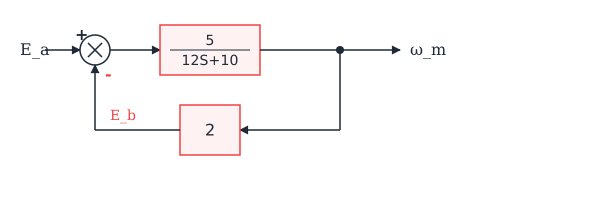
3. Assembling the Initial Block Diagram

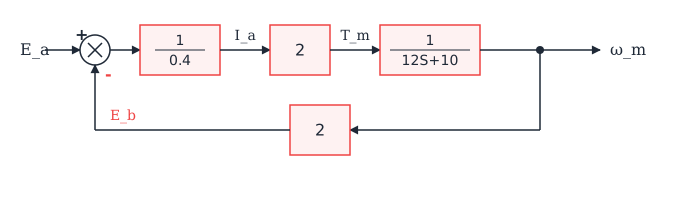
By mapping our separated S-domain equations into graphical blocks, we construct the interconnected system:

Initial DC Motor Block Diagram

4. Step 1: Combine Cascaded Blocks

We have three blocks in series in the forward path. Using Rule 1, we multiply them together:

$$G_{forward} = \left( \frac{1}{0.4} \right) \cdot 2 \cdot \left( \frac{1}{12S + 10} \right) = 2.5 \cdot 2 \cdot \frac{1}{12S + 10} = \frac{5}{12S + 10}$$
Step 1 DC Motor Block Diagram

5. Step 2: Eliminate Feedback Loop

Now we have a classic negative feedback loop. We apply the closed-loop formula $\frac{G}{1+GH}$ where $G = \frac{5}{12S+10}$ and $H = 2$.

$$\frac{\omega_m(s)}{E_a(s)} = \frac{ \frac{5}{12S+10} }{ 1 + \left(\frac{5}{12S+10} \cdot 2\right) } = \frac{ \frac{5}{12S+10} }{ \frac{12S+10 + 10}{12S+10} }$$

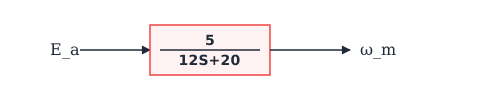
Simplifying the fraction gives us the final Transfer Function:

Final DC Motor Block Diagram
$$\frac{\omega_m(s)}{E_a(s)} = \frac{5}{12S + 20}$$

Generalization: DC Motor Transient State ($L_a \neq 0$)

DC Motor Physical Circuit with Inductance

In the previous numerical example, we analyzed the motor in steady-state, where the inductor acts as a short circuit ($L_a = 0$). However, for a complete dynamic analysis (transient state), the armature inductance $L_a$ must be included in the electrical impedance.

1. The Generalized Block Diagram

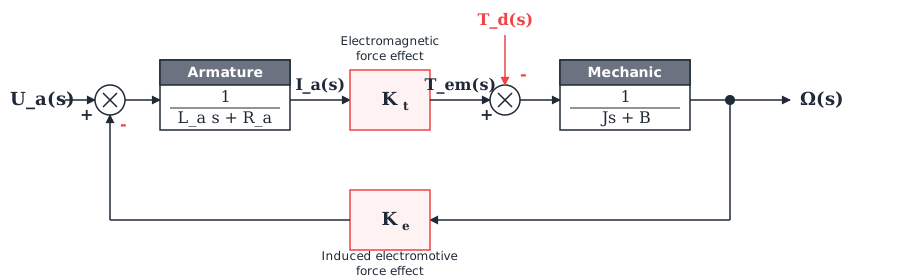
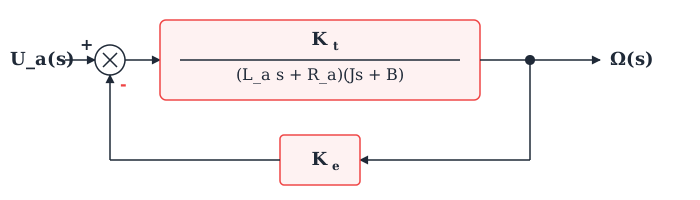
Using the exact variables from standard control theory (where $U_a$ is the input voltage, $K_t$ is the torque constant, and $K_e$ is the back-EMF constant), the generalized block diagram is:

Generalized DC Motor Block Diagram
2. Step 1: Forward Path Combination

Assuming no load disturbance ($T_d(s) = 0$), we combine the Armature, Electromagnetic force, and Mechanic blocks in series by multiplying them:

$$G_{forward}(s) = \left( \frac{1}{L_a s + R_a} \right) \cdot K_t \cdot \left( \frac{1}{Js + B} \right) = \frac{K_t}{(L_a s + R_a)(Js + B)}$$
Step 1 Generalized Reduction
3. Step 2: Feedback Loop Elimination

We apply the negative feedback rule $T(s) = \frac{G}{1 + GH}$ with the feedback sensor gain $H(s) = K_e$:

$$\frac{\Omega(s)}{U_a(s)} = \frac{ \frac{K_t}{(L_a s + R_a)(Js + B)} }{ 1 + \left( \frac{K_t}{(L_a s + R_a)(Js + B)} \cdot K_e \right) }$$

To simplify the complex fraction, we multiply the numerator and denominator by the common denominator $(L_a s + R_a)(Js + B)$, yielding the ultimate generalized Transfer Function of a DC Motor:

$$\frac{\Omega(s)}{U_a(s)} = \frac{K_t}{(L_a s + R_a)(Js + B) + K_t K_e}$$
Final Generalized DC Motor Block Diagram

Example 2: Complex Multi-Loop Reduction

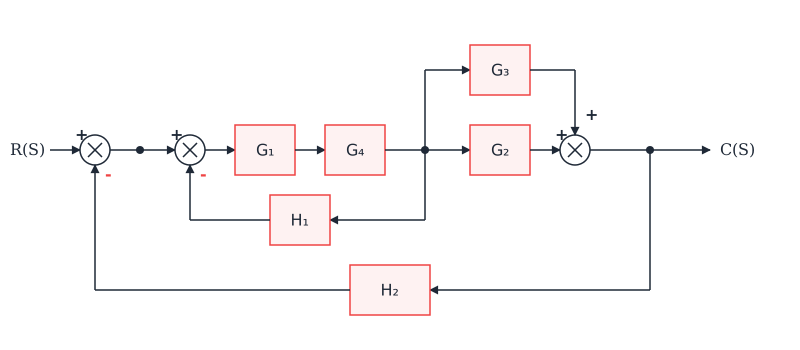
Let's analyze a complex mathematical system containing parallel paths, series blocks, an inner feedback loop, and an outer feedback loop.

Complex Multi-Loop Reduction Diagram

Example Walkthrough: Multi-Loop Reduction

  1. Identify Series Blocks: Look for blocks connected directly in sequence. $G_1$ flows directly into $G_4$, they can be combined into a single block.
    $$G_{14} = G_1 \cdot G_4$$
  2. Identify Parallel (Feedforward) Paths: The input splits, passes through $G_2$ and $G_3$, and meets at a summing junction. They are strictly in parallel.
    $$G_{23} = G_3 + G_2$$
  3. Resolve Inner Feedback Loop: The new block $G_{14}$ is in a negative feedback loop with the sensor $H_1$. Apply the negative feedback rule:
    $$G_{inner} = \frac{G_1 G_4}{1 + G_1 G_4 H_1}$$
  4. Combine the New Forward Path: Multiply the newly resolved inner loop ($G_{inner}$) by the parallel block combination ($G_{23}$) that sits in series with it:
    $$G_{forward} = \left( \frac{G_1 G_4}{1 + G_1 G_4 H_1} \right) \cdot (G_3 + G_2)$$
  5. Resolve Final Outer Loop: Finally, the entire forward path $G_{forward}$ is enclosed in a massive outer negative feedback loop with $H_2$. Apply the $\frac{G_{forward}}{1 + G_{forward} H_2}$ rule again:
    $$T(s) = \frac{\frac{G_1 G_4 (G_3 + G_2)}{1 + G_1 G_4 H_1}}{1 + \left( \frac{G_1 G_4 (G_3 + G_2)}{1 + G_1 G_4 H_1} \right) H_2}$$

    Final Simplification:

    Multiply numerator and denominator by the common denominator $(1 + G_1 G_4 H_1)$ to achieve the final, clean overall Transfer Function.

    $$T(s) = \frac{G_1 G_4 (G_3 + G_2)}{1 + G_1 G_4 H_1 + G_1 G_4 (G_3 + G_2) H_2}$$