Control SystemsSection 4

Time Response Analysis

Analyzing how a system's output behaves over time in response to various inputs. This includes transient behavior, stability, and steady-state performance.

1. Introduction to Time Response Analysis
In this part of the course, we study the response of the output of a system in the time domain, rather than the frequency or S-domain. We want to see exactly how our system (or electrical circuit) responds to different types of inputs.

Course Diagram

The Mathematical Process

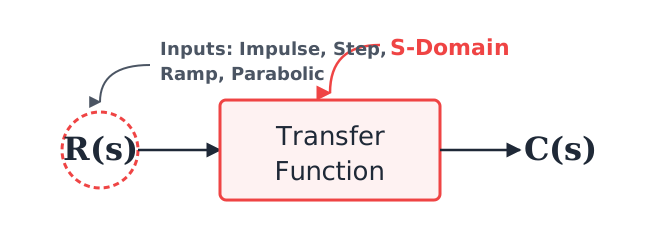
As shown in the block diagram, our input $R(s)$ interacts with our system in the S-domain. To analyze the real-world behavior in the time domain, we follow this sequence:

  1. Find the Output in S-Domain: The output $C(s)$ is simply the product of the input $R(s)$ and the system's Transfer Function (TF).

    $$C(s) = R(s) \times \text{Transfer Function}$$
  2. Convert to Time Domain: We use the Inverse Laplace Transform to convert $C(s)$ into $c(t)$ to observe the physical response over time.

    $$c(t) = \mathcal{L}^{-1}\{C(s)\}$$

Key Takeaway: The final time response $c(t)$ and $C(s)$ depend entirely on two factors: the type of input given to the system, and the poles of the Transfer Function (which characterize the system). Therefore, we need to understand the different types of inputs and the different types of transfer functions.

Types of Test Inputs

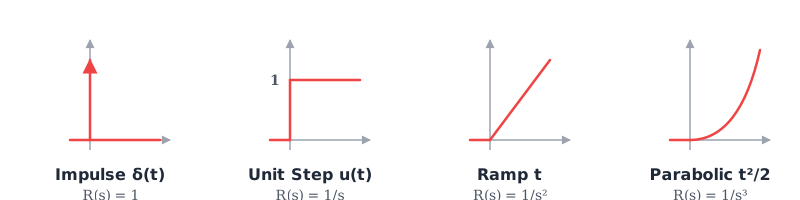
What are the different types of inputs we are going to provide to our system? We use standard signals: Impulse, Step, Ramp, and Parabolic. Let's see them in the time domain and understand how they look in the frequency (S) domain.

Course Diagram

1. The Impulse Input ($\delta(t)$)

What does an impulse even mean? An impulse means that our input will reach a very large value (approaching infinity) at one specific time, and will be strictly equal to zero everywhere else in the time domain. It represents a sudden, instantaneous shock.

In general, an impulse is denoted as $\delta(t - t_0)$, where $t_0$ represents the phase shift or the exact location in time where the impulse occurs. When we simply say $\delta(t)$, it implies $t_0 = 0$. Therefore, at exactly $t = 0$, the signal spikes to infinity, and immediately after $t = 0$, everything drops back to zero.

Mathematical Representation:

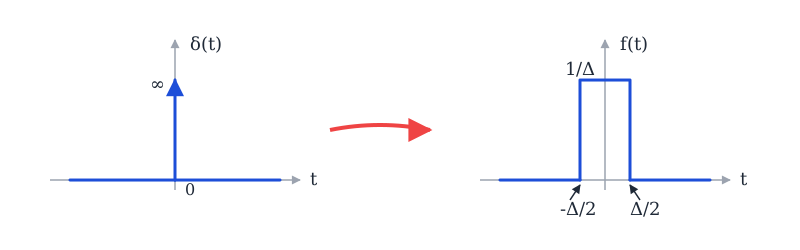
To understand it mathematically, we approximate the impulse as a rectangle with width $\Delta$ (from $-\Delta/2$ to $\Delta/2$) and height $1/\Delta$. As the width $\Delta$ approaches $0$, the height $1/\Delta$ approaches infinity, but the total area remains exactly $1$.

Course Diagram
$$\delta(t) = \lim_{\Delta \to 0} \frac{u(t + \frac{\Delta}{2}) - u(t - \frac{\Delta}{2})}{\Delta}$$

The Sifting Property (Dirac Delta Rule):

To understand how to integrate this function, we must use a very important mathematical rule regarding the Dirac delta. Suppose you want to get the summation (from $-\infty$ to $\infty$) of an impulse $\delta(n-m)$ occurring at a specific point $m$, multiplied by another function $x(n)$:

$$\sum_{n=-\infty}^{\infty} \delta(n-m) \cdot x(n) = x(m)$$

If you simplify this summation and expand it ($\dots + \delta(0)x(0) + \delta(1)x(1) + \dots$), you will find that every single delta is equal to zero, except the one specific delta exactly at the point of occurrence $m$. Therefore, the entire summation collapses to just one specific value: the function evaluated at the point of occurrence, $x(m)$.

Deriving the Laplace Transform:

How do we get its Laplace transform? The general definition of the Laplace transform is the integration (which is simply the continuous equivalent of a summation representing the area under the curve) from $-\infty$ to $\infty$ of $f(t)e^{-st}dt$. If we substitute $f(t) = \delta(t)$:

$$\mathcal{L}[\delta(t)] = \int_{-\infty}^{\infty} \delta(t) e^{-st} dt$$

By applying our Sifting Rule, our impulse $\delta(t)$ occurs exactly at time $t = 0$. Any other point in this integration will be equal to zero. Thus, the integral evaluates to just one specific value: the function $e^{-st}$ at the exact point where the impulse exists ($t = 0$):

$$\mathcal{L}[\delta(t)] = 1 \cdot e^{-s(0)} = 1 \cdot 1 = 1$$

This proves mathematically why the Laplace transform of a unit impulse is exactly $R(s) = 1$.

2. Step Input

Represents a constant DC input applied at $t=0$.

  • Time domain: $f(t) = A$
  • S-Domain: $R(s) = \frac{A}{s}$

For a Unit Step, $A=1$, yielding $R(s) = \frac{1}{s}$.

3. Ramp Input

Represents an input changing at a constant velocity.

  • Time domain: $f(t) = A \cdot t$
  • S-Domain: $R(s) = \frac{A}{s^2}$

For a Unit Ramp, $A=1$, yielding $R(s) = \frac{1}{s^2}$.

4. Parabolic Input

Represents an input with constant acceleration.

  • Time domain: $f(t) = A \cdot t^2$
  • S-Domain: $R(s) = \frac{2A}{s^3}$

For a Unit Parabolic ($t^2/2$), $R(s) = \frac{1}{s^3}$.

Types of Transfer Functions & System Order

We've just learned about the different types of inputs we can supply to our system. But what about the different types of transfer functions? Transfer functions are classified and divided according to their Characteristic Equation.

The Characteristic Equation ($1 + GH = 0$)

If you look at a standard negative feedback system with a forward gain $G(s)$ and a feedback path $H(s)$, the overall transfer function is $\frac{C(s)}{R(s)} = \frac{G(s)}{1 + G(s)H(s)}$.

As we will see later in the course, the transient response of a system (whether it stabilizes smoothly, oscillates, or becomes an unstable system going to infinity) is strictly dependent on two parts:

  1. What kind of input we are giving it.
  2. The Characteristic Equation.

This equation characterizes the entire behavior of the system. We find it by taking the denominator of the transfer function and equating it to zero:

$$1 + G(s)H(s) = 0$$

When we equate this to zero, we are solving for the poles of the system. Because $1/0$ gives us infinity, the poles are the exact values of $s$ that make the transfer function go to infinity. These poles are what provide the different physical responses of the system.

Determining the Order of the System:

How many poles do we have? The way the characteristic equation looks, specifically its highest power of $s$, determines whether the system is a first-order, second-order, third-order, or even a higher-order system.

First-Order System

If the characteristic equation has only one root (one solution), the highest power of $s$ is 1.

$$1 + \tau s = 0 \implies s = -\frac{1}{\tau}$$

Second-Order System

If the characteristic equation is a quadratic equation (highest power is 2), it will yield two roots.

$$s^2 + 2\zeta\omega_n s + \omega_n^2 = 0$$

Similarly, if you have an $s^3$ term, the system will be a third-order system with three roots characterizing its behavior.

2. First-Order Systems

A first-order system is one where the highest power of $s$ in the characteristic equation (the denominator) is 1. Before analyzing its response, let's see how the standard form is derived.

Deriving the Standard Form

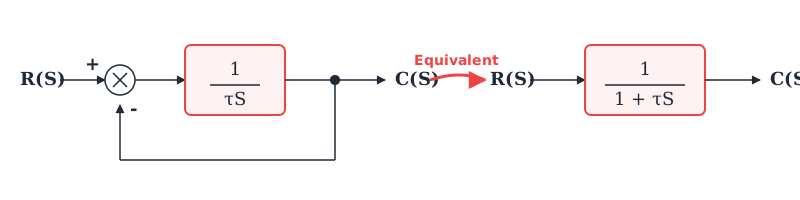
A first-order system can often be modeled with a forward gain block $G(s) = \frac{1}{\tau s}$ and a unity negative feedback loop $H(s) = 1$. Let's calculate the overall closed-loop transfer function:

Course Diagram
$$\frac{C(s)}{R(s)} = \frac{G(s)}{1 + G(s)H(s)} = \frac{\frac{1}{\tau s}}{1 + \frac{1}{\tau s}(1)}$$

To simplify this complex fraction, we multiply the numerator and the denominator by $\tau s$, giving us the standard transfer function for a first-order system:

$$\frac{C(s)}{R(s)} = \frac{1}{1 + \tau s}$$

Where $\tau$ (Tau) is the Time Constant. Notice that the denominator $1 + \tau s$ has $s$ to the power of 1, confirming it is a first-order system.

Analyzing the Responses

1. Impulse Response

For an impulse response, our input in the S-domain is a constant: $R(s) = 1$.

The output $C(s)$ is the input multiplied by the transfer function:

$$C(s) = 1 \times \frac{1}{1 + \tau s} = \frac{1}{1 + \tau s}$$

To convert this back to the time domain, we need to match it with a standard Laplace formula from our tables, specifically $\frac{1}{s + a}$, which corresponds to $e^{-at}$. To do this, we take $\tau$ as a common factor in the denominator:

$$C(s) = \frac{1}{\tau(s + \frac{1}{\tau})} = \frac{1/\tau}{s + 1/\tau}$$

Now, our equation is in the exact form $\frac{A}{s + a}$ where $A = \frac{1}{\tau}$ and $a = \frac{1}{\tau}$. Applying the Inverse Laplace Transform yields:

$$c(t) = \frac{1}{\tau} e^{-t/\tau}$$

Evaluating Boundary Conditions ($t=0$ to $t \to \infty$):

  • Initial Value (at $t = 0$): Substitute $t=0$ into the equation. Since $e^0 = 1$, we get $c(0) = \frac{1}{\tau}$. The response starts at a high initial value.
  • Steady State Value (at $t \to \infty$): As time becomes very large, $e^{-\infty} = \frac{1}{e^\infty} = 0$. Anything multiplied by zero is zero, so $c(\infty) = 0$.
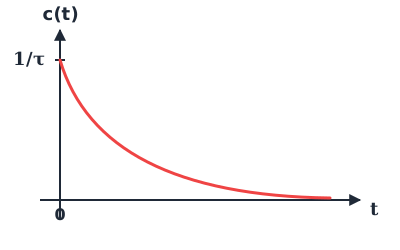
Logical Conclusion: We provided a sudden, temporary shock (impulse) to the system. As time passes, the input disappears completely, so naturally, the system's output eventually decays and drops back to zero.

Course Diagram

2. Unit Step Response & RC Circuit Application

For a unit step response, our input in the time domain is a constant $1$. In the S-domain, this is: $R(s) = \frac{1}{s}$.

The output $C(s)$ is the input multiplied by the transfer function:

$$C(s) = \frac{1}{s} \times \frac{1}{1 + \tau s} = \frac{1}{s(1 + \tau s)}$$

The Problem: Table Mismatch

If we look at our standard Laplace transform table, we do not have any direct form that is suitable for $\frac{1}{s(1 + \tau s)}$. To solve this, we must use Partial Fraction Expansion to split this single multiplication into two simpler fractions.

Mathematical Derivation (Partial Fractions):

First, take $\tau$ as a common factor in the denominator to isolate $s$:

$$C(s) = \frac{1/\tau}{s(s + \frac{1}{\tau})}$$

Now, we split this into two fractions with unknown coefficients $A$ and $B$:

$$\frac{1/\tau}{s(s + \frac{1}{\tau})} = \frac{A}{s} + \frac{B}{s + \frac{1}{\tau}}$$

Equating the numerators yields the main equation:

$$\frac{1}{\tau} = A\left(s + \frac{1}{\tau}\right) + Bs$$

Substitute $s = 0$:

$$\frac{1}{\tau} = A\left(0 + \frac{1}{\tau}\right) + B(0) \implies \mathbf{A = 1}$$

Substitute $s = -\frac{1}{\tau}$:

$$\frac{1}{\tau} = A(0) + B\left(-\frac{1}{\tau}\right) \implies \mathbf{B = -1}$$

Substituting $A$ and $B$ back into our split fractions gives us a form ready for the Inverse Laplace Transform:

$$C(s) = \frac{1}{s} - \frac{1}{s + \frac{1}{\tau}}$$

From the Laplace table, $\frac{1}{s} \to 1$, $\frac{1}{s+a} \to e^{-at}$. Therefore, the final time response is:

$$c(t) = 1 - e^{-t/\tau}$$

Evaluating Boundary Conditions ($t=0$ to $t \to \infty$):

  • Initial Value (at $t = 0$): $c(0) = 1 - e^0 = 1 - 1 = \mathbf{0}$. The system starts at zero.
  • Steady State Value (at $t \to \infty$): $c(\infty) = 1 - e^{-\infty} = 1 - 0 = \mathbf{1}$. The system charges exponentially and eventually reaches the exact steady-state value of the input step.

How does this represent reality? (The RC Circuit)
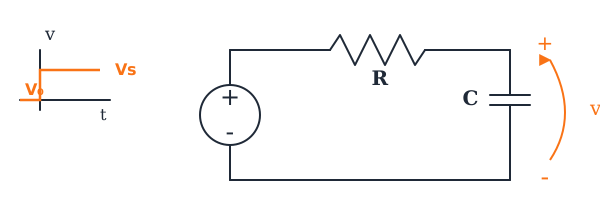
Let's look at a standard electrical circuit with a voltage supply, a resistor ($R$), and a capacitor ($C$). We want to find the relationship between the output voltage $v(t)$ (across the capacitor) and the input supply $V_S$.

Course Diagram

Using the voltage division rule in the S-domain, the voltage across the capacitor is the total supply voltage multiplied by the capacitor's impedance divided by the total impedance:

$$V_{out}(s) = V_S(s) \times \frac{\frac{1}{sC}}{R + \frac{1}{sC}}$$

If we multiply the numerator and the denominator by $sC$ to simplify it, we get:

$$\text{Transfer Function} = \frac{V_{out}(s)}{V_S(s)} = \frac{1}{1 + sRC}$$

Notice that the product of Resistance and Capacitance ($RC$) is exactly equal to our time constant ($\tau$). Thus, this circuit is a perfect physical representation of the first-order system transfer function $\frac{1}{1 + \tau s}$.

The Physical Translation:

If we supply a DC voltage (which is a step input) starting from 0, the capacitor will start charging. It will keep charging exponentially until it reaches the steady-state value of the supply voltage $V_S$. This physical reality perfectly matches the mathematical curve $c(t) = 1 - e^{-t/\tau}$ we derived above!

Crucial Math Tool: Partial Fraction Rules

Before analyzing the Ramp response, we must review the general rules for dividing complex rational functions into simpler partial fractions so we can use the Laplace tables. Here are the standard forms you must memorize:

Form of the rational functionForm of the partial function
$$\frac{px+q}{(x-a)(x-b)} \quad (a \neq b)$$$$\frac{A}{x-a} + \frac{B}{x-b}$$
$$\frac{px+q}{(x-a)^2}$$$$\frac{A}{x-a} + \frac{B}{(x-a)^2}$$
$$\frac{px^2+qx+r}{(x-a)(x-b)(x-c)}$$$$\frac{A}{x-a} + \frac{B}{x-b} + \frac{C}{x-c}$$
$$\frac{px^2+qx+r}{(x-a)^2(x-b)}$$$$\frac{A}{x-a} + \frac{B}{(x-a)^2} + \frac{C}{x-b}$$
$$\frac{px^2+qx+r}{(x-a)(x^2-bx+c)}$$$$\frac{A}{x-a} + \frac{Bx+C}{x^2-bx+c}$$

3. Unit Ramp Response

For a unit ramp response, the input in the time domain is $r(t) = t$. In the S-domain, this translates to: $R(s) = \frac{1}{s^2}$.

The output $C(s)$ is the input multiplied by the transfer function:

$$C(s) = \frac{1}{s^2} \times \frac{1}{1 + \tau s} = \frac{1/\tau}{s^2(s + \frac{1}{\tau})}$$

Mathematical Derivation (Partial Fractions):

Looking at our rules above, since we have an $s^2$ term (a squared root), we must divide it into three partial fractions ($A, B,$ and $C$):

$$\frac{1/\tau}{s^2(s + \frac{1}{\tau})} = \frac{A}{s} + \frac{B}{s^2} + \frac{C}{s + \frac{1}{\tau}}$$

Multiply everything by the common denominator $s^2(s + \frac{1}{\tau})$ to get the main characteristic equation:

$$\frac{1}{\tau} = A \cdot s\left(s + \frac{1}{\tau}\right) + B\left(s + \frac{1}{\tau}\right) + C \cdot s^2$$

Now we substitute specific values for $s$ to eliminate terms and find our coefficients:

At $s = 0$:

$$\frac{1}{\tau} = 0 + B\left(0 + \frac{1}{\tau}\right) + 0 \implies \mathbf{B = 1}$$

At $s = -\frac{1}{\tau}$:

$$\frac{1}{\tau} = 0 + 0 + C\left(-\frac{1}{\tau}\right)^2 \implies \frac{1}{\tau} = C\left(\frac{1}{\tau^2}\right) \implies \mathbf{C = \tau}$$

At $s = 1$ (or equating $s^2$ coefficients): The $s^2$ terms on the right are $As^2 + Cs^2$. There is no $s^2$ term on the left ($0s^2$). So:

$$A + C = 0 \implies A = -C \implies \mathbf{A = -\tau}$$

Substituting $A, B,$ and $C$ back into our split fractions gives us:

$$C(s) = \frac{-\tau}{s} + \frac{1}{s^2} + \frac{\tau}{s + \frac{1}{\tau}}$$

From the Laplace table, $\frac{1}{s} \to 1$, $\frac{1}{s^2} \to t$, and $\frac{1}{s+a} \to e^{-at}$. Applying the Inverse Laplace Transform yields the final time response:

$$c(t) = -\tau + t + \tau e^{-t/\tau}$$

Evaluating Boundary Conditions ($t=0$ to $t \to \infty$):

  • Initial Value (at $t = 0$): $c(0) = -\tau + 0 + \tau(e^0) = -\tau + \tau = \mathbf{0}$. The system starts at zero.
  • Steady State Value (at $t \to \infty$): $c(\infty) = -\tau + \infty + \tau(0) = \mathbf{\infty}$. The output grows indefinitely.
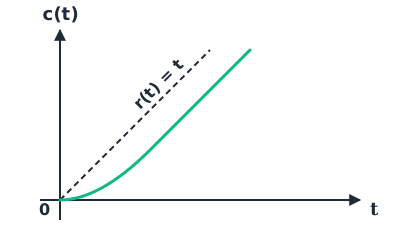
Logical Conclusion: Because the final value is $\infty$, the concept of a "settling time" or reaching a stable steady state is mathematically undefined. The system perfectly mimics the ramp input but with a constant time delay ($\tau$).

Course Diagram

Mathematical Relation Between Responses

Is it a coincidence that these formulas look related? Not at all! Look closely at the Laplace domain inputs:

  • Impulse: $R(s) = 1$
  • Unit Step: $R(s) = \frac{1}{s}$
  • Unit Ramp: $R(s) = \frac{1}{s^2}$

In the S-domain, multiplying by $s$ is mathematically equivalent to taking a derivative in the time domain. Therefore:

  • If you multiply the Step Response $C_{step}(s)$ by $s$, you get the Impulse Response $C_{impulse}(s)$. Translated into the time domain: The output of the impulse function is the exact derivative of the unit step output.
  • If you multiply the Ramp Response $C_{ramp}(s)$ by $s$, you get the Step Response $C_{step}(s)$. Translated into the time domain: The output of the unit step function is the exact derivative of the ramp function output.

Time Response Specifications of a 1st Order System

When designing a controller, we need specific metrics to characterize and compare the responses of different systems. For a first-order system subjected to a unit step input, we define several key performance specifications:

1. Final Value Theorem (Steady State Value)

The steady-state value is the final value the output reaches as time approaches infinity ($t \to \infty$). Using the Final Value Theorem, we can calculate this steady-state value directly from the S-domain without needing to convert the function to the time domain:

$$\lim_{t \to \infty} c(t) = \lim_{s \to 0} s \cdot C(s)$$

For our first-order unit step response where $C(s) = \frac{1}{s(1+\tau s)}$:

$$\lim_{s \to 0} s \cdot \left( \frac{1}{s(1+\tau s)} \right) = \lim_{s \to 0} \frac{1}{1+\tau s} = \frac{1}{1+0} = 1$$

2. Time Constant ($\tau$)

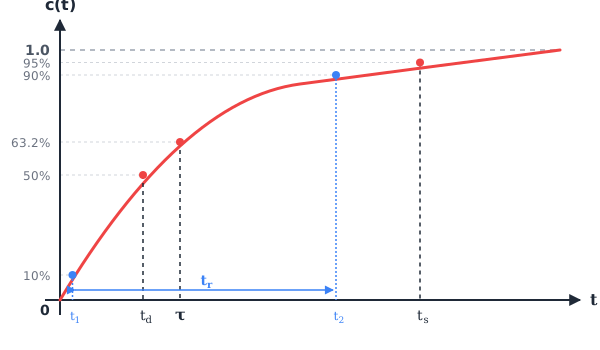
A measure of the speed of response of the system. It is the time required for the system's response to reach approximately 63.2% of its final value in response to a step input. (Mathematically: $c(\tau) = 1 - e^{-1} \approx 0.632$).

3. Delay Time ($t_d$)

The time taken for the system's response to reach exactly 50% of its final steady-state value for the very first time.

4. Rise Time ($t_r$)

The time required for the system's response to go from 10% to 90% of its final value. We calculate the time at 10% ($t_1$) and 90% ($t_2$), and the rise time is $t_2 - t_1$. For a standard first-order system, this is approximately: $t_r \approx 2.2\tau$.

5. Settling Time ($t_s$)

The time required for the system's response to reach and remain within a certain error band (commonly 2% or 5%) of its final value. Because a first-order system never oscillates (it doesn't go in and out of the band), it simply enters and stays.

  • For a 5% criterion (reaches 95%): $t_s \approx 3\tau$
  • For a 2% criterion (reaches 98%): $t_s \approx 4\tau$
Course Diagram

3. Second-Order Systems

Second-order systems are the most important in control theory because they introduce the physical phenomena of oscillation and damping.

Deriving the Standard Form

A standard second-order system is modeled with a forward path gain $G(s) = \frac{\omega_n^2}{s(s + 2\zeta\omega_n)}$ and a unity negative feedback loop $H(s) = 1$. Using the closed-loop formula $\frac{G}{1+GH}$:

$$\frac{C(s)}{R(s)} = \frac{\frac{\omega_n^2}{s(s + 2\zeta\omega_n)}}{1 + \frac{\omega_n^2}{s(s + 2\zeta\omega_n)}(1)}$$

Multiplying numerator and denominator by $s(s + 2\zeta\omega_n)$ yields the universal standard transfer function for a second-order system:

$$\frac{C(s)}{R(s)} = \frac{\omega_n^2}{s^2 + 2\zeta\omega_n s + \omega_n^2}$$

As established previously, the transient response of any system is strictly dependent on two factors: the type of input we supply, and its Characteristic Equation. For the second-order system, the characteristic equation is the denominator equated to zero: $s^2 + 2\zeta\omega_n s + \omega_n^2 = 0$.

The Two Key Parameters

The entire behavior of the system is governed by two variables present in this equation:

  • $\omega_n$ (Natural Frequency): Represents the inherent oscillatory nature of the system. It is the frequency at which the system would freely oscillate if there were absolutely no damping (no friction, no resistance) present.
  • $\zeta$ (Damping Ratio, "Zeta"): A dimensionless coefficient that determines how these oscillations will decay over time after a disturbance (e.g., a step input). It represents the damping inside the system. The higher the zeta, the faster the oscillations are killed.

Solving the Characteristic Equation & System Poles
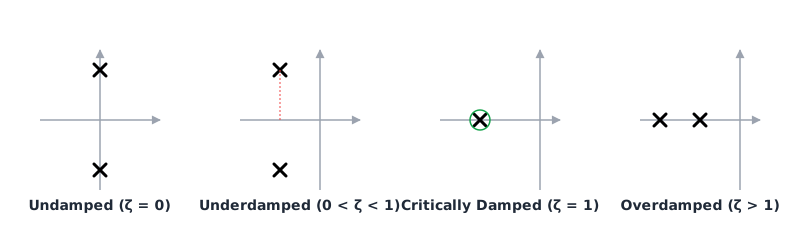
To find the system's poles (the values of $s$ that make the transfer function infinite), we must solve the characteristic equation using the standard quadratic formula: $s = \frac{-b \pm \sqrt{b^2 - 4ac}}{2a}$.

Here, $a = 1$, $b = 2\zeta\omega_n$, and $c = \omega_n^2$. Plugging these into the formula:

$$s_{1,2} = \frac{-2\zeta\omega_n \pm \sqrt{(2\zeta\omega_n)^2 - 4(1)(\omega_n^2)}}{2} = \frac{-2\zeta\omega_n \pm \sqrt{4\zeta^2\omega_n^2 - 4\omega_n^2}}{2}$$

Factor out $4\omega_n^2$ from under the square root ($\sqrt{4\omega_n^2} = 2\omega_n$):

$$s_{1,2} = \frac{-2\zeta\omega_n \pm 2\omega_n\sqrt{\zeta^2 - 1}}{2}$$

Divide by 2 to get the final, extremely important general solution for the poles of a second-order system:

$$s_{1,2} = -\zeta\omega_n \pm \omega_n\sqrt{\zeta^2 - 1}$$

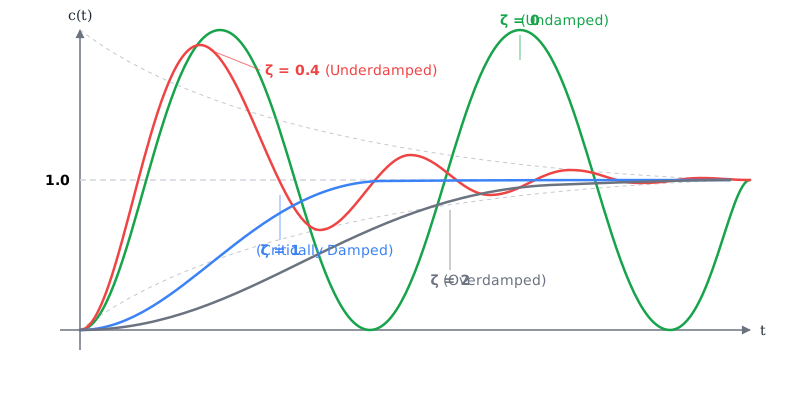
Look carefully at the term under the square root: $(\zeta^2 - 1)$. Because the damping ratio $\zeta$ dictates this value, it creates four entirely distinct physical behaviors (or cases) depending on whether the root is real, zero, or imaginary (negative).

Course Diagram

1. Underdamped ($0 \le \zeta < 1$)

If $\zeta$ is less than 1, the term $(\zeta^2 - 1)$ is negative. We extract $-1$ from the root to get the imaginary number $j$. The roots become complex conjugates:

$$s_{1,2} = -\zeta\omega_n \pm j\omega_n\sqrt{1-\zeta^2}$$

We define $\omega_d = \omega_n\sqrt{1-\zeta^2}$ as the Damped Natural Frequency. The real part ($-\zeta\omega_n$) translates to an exponential decay in time, and the imaginary part ($j\omega_d$) translates to sine/cosine oscillations. This system overshoots and oscillates before settling.

2. Critically Damped ($\zeta = 1$)

If $\zeta = 1$, the square root becomes zero ($\sqrt{1^2 - 1} = 0$). We are left with two equal real roots:

$$s_1 = s_2 = -\omega_n$$

Because there is no imaginary part, there are zero oscillations. This is the exact mathematical threshold between an oscillating system and a sluggish one. It returns to steady state as fast as possible without overshooting.

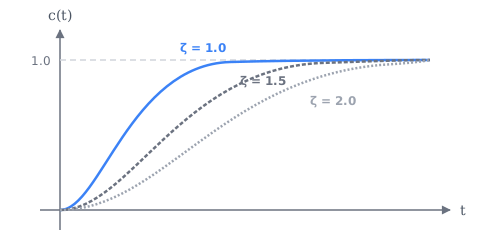
3. Overdamped ($\zeta > 1$)

If $\zeta$ is greater than 1, the square root is a positive real number. We get two distinct real roots.

$$s_{1,2} = -\zeta\omega_n \pm \omega_n\sqrt{\zeta^2 - 1}$$

Again, there is no imaginary part ($j$), so there are no oscillations. The response is purely exponential. Because the damping is so heavy, the system is very sluggish and takes a long time to reach its final value.

4. Undamped ($\zeta = 0$)

If there is zero damping, the real part disappears entirely. We get two purely imaginary roots:

$$s_{1,2} = \pm j\omega_n$$

Since the real part is zero, there is no exponential decay. The system will oscillate infinitely at its natural frequency $\omega_n$ without ever settling down.

Course Diagram

Deep Dive: Deriving the Underdamped Step Response ($0 < \zeta < 1$)

Let's prove mathematically how the complex poles translate into the standard decaying oscillatory response for a unit step input ($R(s) = 1/s$).

$$C(s) = \frac{1}{s} \cdot \frac{\omega_n^2}{s^2 + 2\zeta\omega_n s + \omega_n^2}$$

1. Partial Fraction Expansion

Because $\zeta < 1$, the quadratic denominator cannot be factored into real roots. We must use the partial fraction rule for an unfactorable quadratic ($Bs + C$):

$$\frac{\omega_n^2}{s(s^2 + 2\zeta\omega_n s + \omega_n^2)} = \frac{A}{s} + \frac{Bs + C}{s^2 + 2\zeta\omega_n s + \omega_n^2}$$

Multiplying by the denominator gives us the main equation:

$$\omega_n^2 = A(s^2 + 2\zeta\omega_n s + \omega_n^2) + (Bs + C)s$$

We group the terms by the powers of $s$ ($s^2$, $s^1$, and $s^0$):

$$0s^2 + 0s^1 + \omega_n^2 = s^2(A + B) + s(2\zeta\omega_n A + C) + A\omega_n^2$$

By comparing the coefficients on both sides, we get three simple equations:

For $s^0$:

$$\omega_n^2 = A\omega_n^2 \implies \mathbf{A = 1}$$

For $s^1$:

$$0 = 2\zeta\omega_n A + C \implies 0 = 2\zeta\omega_n(1) + C \implies \mathbf{C = -2\zeta\omega_n}$$

For $s^2$:

$$0 = A + B \implies 0 = 1 + B \implies \mathbf{B = -1}$$

Substitute these values back into $C(s)$:

$$C(s) = \frac{1}{s} - \frac{s + 2\zeta\omega_n}{s^2 + 2\zeta\omega_n s + \omega_n^2}$$

2. Completing the Square to Match Laplace Tables

We want to match the standard Laplace transform forms for exponential sine and cosine. Let's recall these crucial rules:

  • $\mathcal{L}[e^{-at}\cos(\omega t)] = \frac{s+a}{(s+a)^2 + \omega^2}$
  • $\mathcal{L}[e^{-at}\sin(\omega t)] = \frac{\omega}{(s+a)^2 + \omega^2}$

First, we complete the square in the denominator so it matches $(s+a)^2 + \omega^2$:

$$s^2 + 2\zeta\omega_n s + \omega_n^2 = (s + \zeta\omega_n)^2 + \omega_n^2 - \zeta^2\omega_n^2 = \mathbf{(s + \zeta\omega_n)^2 + \omega_d^2}$$

Next, we split the numerator $(s + 2\zeta\omega_n)$ to create an $(s + \zeta\omega_n)$ term for the cosine, leaving an extra $\zeta\omega_n$ for the sine:

$$C(s) = \frac{1}{s} - \left[ \frac{s + \zeta\omega_n}{(s + \zeta\omega_n)^2 + \omega_d^2} + \frac{\zeta\omega_n}{(s + \zeta\omega_n)^2 + \omega_d^2} \right]$$

To make the second fraction perfectly match the sine formula (which requires $\omega_d$ in the numerator), we multiply and divide it by $\omega_d$ (where $\omega_d = \omega_n\sqrt{1-\zeta^2}$):

$$C(s) = \frac{1}{s} - \frac{s + \zeta\omega_n}{(s + \zeta\omega_n)^2 + \omega_d^2} - \left( \frac{\zeta}{\sqrt{1-\zeta^2}} \right) \frac{\omega_d}{(s + \zeta\omega_n)^2 + \omega_d^2}$$

3. The Final Time Domain Equation

Now every term directly matches the Inverse Laplace tables. The final physical response of the underdamped system is:

$$c(t) = 1 - e^{-\zeta\omega_n t} \left[ \cos(\omega_d t) + \frac{\zeta}{\sqrt{1-\zeta^2}} \sin(\omega_d t) \right]$$

Connecting the Poles to the Physical Response

If you look carefully at the final equation, it consists of two distinct behaviors multiplying each other: an exponential part ($e^{-\zeta\omega_n t}$) and an oscillatory part ($\cos$ and $\sin$). This directly translates from the roots (poles) of the characteristic equation we solved earlier:

$$s_{1,2} = \underbrace{-\zeta\omega_n}_{\text{Real Part}} \pm j\underbrace{\omega_n\sqrt{1-\zeta^2}}_{\text{Imaginary Part} (\omega_d)}$$
  • The Real Part ($-\zeta\omega_n$): In the Laplace transform, a real part translates strictly to an exponential response. This dictates how fast the transient response decays.
  • The Imaginary Part ($j\omega_d$): The imaginary $j$ component translates strictly into an oscillatory response (sine/cosine waves).

What happens as we change $\zeta$?

  • $\zeta = 0$ (Undamped): The real part is zero ($e^0 = 1$), and $\omega_d$ becomes $\omega_n$. The response simplifies to $c(t) = 1 - \cos(\omega_n t)$. It oscillates forever at its natural frequency with no decay.
  • $0 < \zeta < 1$ (Underdamped): As $\zeta$ increases (e.g., from 0.1 to 0.9), the exponential decay gets stronger, and the oscillations die out much faster.
  • $\zeta \ge 1$ (Critically / Overdamped): The imaginary part completely disappears from the poles. As a result, the time-domain response becomes purely exponential with absolutely zero oscillations.

Deep Dive: Deriving the Critically Damped Response ($\zeta = 1$)

To find the critically damped response, we could start from the very beginning, perform partial fractions on $C(s) = \frac{1}{s}\frac{\omega_n^2}{(s+\omega_n)^2}$, and use a long inverse Laplace derivation. However, there is a much more elegant mathematical shortcut: taking the limit of our underdamped response equation as $\zeta$ approaches 1.

1. The Indeterminate Form Problem

Let's look at our underdamped formula and try to substitute $\zeta = 1$ directly. Remember that $\omega_d = \omega_n\sqrt{1-\zeta^2}$, so if $\zeta=1$, then $\omega_d = 0$.

$$c(t) = 1 - e^{-(1)\omega_n t} \left( \cos(0 \cdot t) + \frac{1}{\sqrt{1-1^2}} \sin(0 \cdot t) \right)$$

Since $\cos(0) = 1$ and $\sin(0) = 0$, the sine term inside the parenthesis becomes $\frac{0}{0}$. This is a classic mathematical indeterminate form. To resolve this, we cannot just plug in the number; we must evaluate the limit.

2. Applying Limits and L'Hôpital's Rule

We need to evaluate the limit of the problematic sine term as $\zeta \to 1$. Let's define a new variable $x = \sqrt{1-\zeta^2}$. As $\zeta \to 1$, $x \to 0$. Also, notice that $\omega_d = \omega_n x$. The limit becomes:

$$\lim_{x \to 0} \frac{\sin(\omega_n x t)}{x}$$

From calculus (specifically derived via L'Hôpital's rule for $0/0$ limits), we know the standard rule $\lim_{x \to 0} \frac{\sin(ax)}{x} = a$. Applying this to our equation where $a = \omega_n t$, we get:

$$\lim_{x \to 0} \frac{\sin(\omega_n t \cdot x)}{x} = \mathbf{\omega_n t}$$

3. The Final Equation and Physical Meaning

Substituting this solved limit back into the original equation (along with $\cos(0)=1$), we get the final critically damped response:

$$c(t) = 1 - e^{-\omega_n t} (1 + \omega_n t)$$

The Physical Translation of the Poles:

If we look back at the characteristic equation for $\zeta=1$, the complex poles simplify to a single repeated real root: $s_{1,2} = -\omega_n$. Because the imaginary part ($j$) has completely vanished, there is absolutely no oscillatory response ($\sin$/$\cos$). The final time-domain equation above confirms this: it consists only of an exponential response. The system smoothly and rapidly approaches the steady-state without a single oscillation!

Deep Dive: Deriving the Overdamped Step Response ($\zeta > 1$)

Now let's discuss the final case: the overdamped system where $\zeta > 1$. Because the damping ratio is greater than 1, the term under the square root $(\zeta^2 - 1)$ is positive. We have two strictly real, distinct roots.

$$s_{1,2} = -\zeta\omega_n \pm \omega_n\sqrt{\zeta^2 - 1}$$

1. Factorizing the Characteristic Equation

Since the roots are real, we don't need completing the square like in the underdamped case. We can directly factorize the characteristic equation into two distinct components $(s - s_1)(s - s_2)$:

$$s^2 + 2\zeta\omega_n s + \omega_n^2 = (s + \zeta\omega_n - \omega_n\sqrt{\zeta^2 - 1})(s + \zeta\omega_n + \omega_n\sqrt{\zeta^2 - 1})$$

2. Partial Fraction Expansion

For a unit step input $R(s) = 1/s$, the output $C(s)$ has three distinct real poles. We break this down into three partial fractions $A$, $B$, and $C$:

$$C(s) = \frac{\omega_n^2}{s(s + \zeta\omega_n - \omega_n\sqrt{\zeta^2 - 1})(s + \zeta\omega_n + \omega_n\sqrt{\zeta^2 - 1})} = \frac{A}{s} + \frac{B}{s - s_1} + \frac{C}{s - s_2}$$

By multiplying through by the denominator and setting $s=0$, we easily find $A$:

$$\omega_n^2 = A(\zeta\omega_n - \omega_n\sqrt{\zeta^2 - 1})(\zeta\omega_n + \omega_n\sqrt{\zeta^2 - 1}) = A(\zeta^2\omega_n^2 - \omega_n^2(\zeta^2 - 1)) = A(\omega_n^2) \implies \mathbf{A = 1}$$

By substituting $s = s_1$ and $s = s_2$, we algebraically solve for the constants $B$ and $C$:

$$B = \frac{1}{(-\zeta + \sqrt{\zeta^2 - 1})(2\sqrt{\zeta^2 - 1})}$$
$$C = \frac{1}{(\zeta + \sqrt{\zeta^2 - 1})(2\sqrt{\zeta^2 - 1})}$$

3. The Final Time Domain Equation

Since we only have terms in the form $\frac{\text{constant}}{s+a}$, their inverse Laplace transforms are pure exponentials $e^{-at}$. There are no imaginary $j$ components, thus no sine or cosine functions. The final physical response is:

$$c(t) = 1 + B \cdot e^{-(\zeta\omega_n - \omega_n\sqrt{\zeta^2 - 1})t} + C \cdot e^{-(\zeta\omega_n + \omega_n\sqrt{\zeta^2 - 1})t}$$

The Physical Translation: Sluggishness

Because the equation consists only of decaying exponentials, the system will slowly charge toward its steady-state value of 1 without ever overshooting or oscillating.

As $\zeta$ increases (more damping), the system becomes increasingly sluggish. Compared to the critically damped response, an overdamped system takes a significantly longer time to reach its final steady-state value.

Course Diagram

4. Time Response Specifications (Underdamped)
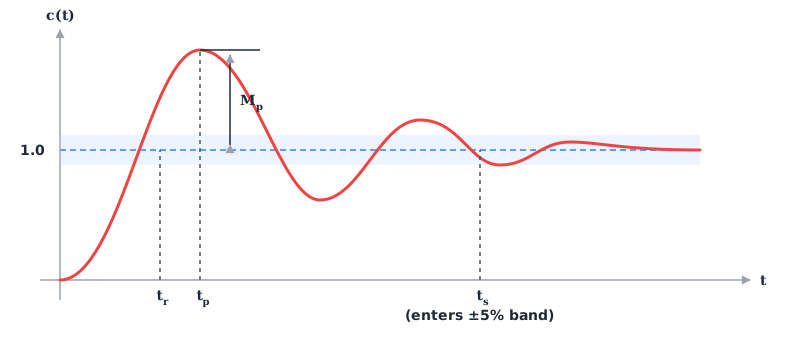
When engineers design a controller (like a PID), they evaluate the system's performance using specific metrics on the Underdamped Step Response curve. We need to calculate exactly when the system peaks, how high it peaks, and when it settles.

Course Diagram

1. Steady State Value (Final Value Theorem)

The steady-state value is the final value the output reaches as time approaches infinity. Using the Final Value Theorem, we calculate this directly from the S-domain by taking the limit of $s \cdot C(s)$ as $s \to 0$. For a unit step input $R(s) = \frac{1}{s}$:

$$c(\infty) = \lim_{s \to 0} s \cdot \left( \frac{1}{s} \cdot \frac{\omega_n^2}{s^2 + 2\zeta\omega_n s + \omega_n^2} \right) = \frac{\omega_n^2}{\omega_n^2} = 1$$

Note: If we have a step input with a specific amplitude $A$ (so $R(s) = \frac{A}{s}$), the steady-state value will simply resolve to $A$. The system tracks the step input perfectly in steady state.

Deep Dive: Deriving Peak Time ($t_p$) and Maximum Overshoot ($\%M_p$)
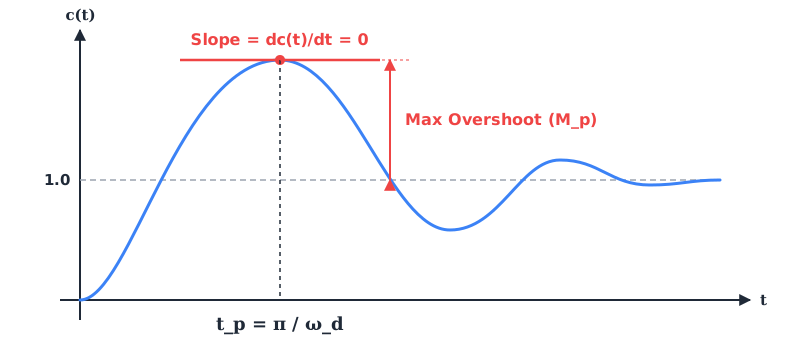
The Peak Time ($t_p$) is the time required for the system response to reach its first maximum peak. Mathematically, the peak value occurs when the slope of the curve is equal to zero. Thus, we must take the derivative of our time-domain response $c(t)$ and equate it to zero: $\frac{dc(t)}{dt} = 0$.

Course Diagram

Step 1: The Derivative

Let's expand the underdamped response equation we previously derived:

$$c(t) = 1 - e^{-\zeta\omega_n t} \cos(\omega_d t) - \frac{\zeta}{\sqrt{1-\zeta^2}} e^{-\zeta\omega_n t} \sin(\omega_d t)$$

Now, we apply the product rule to differentiate with respect to time $t$:

  • The derivative of the constant $1$ is $0$.
  • The derivative of the cosine term generates two parts.
  • The derivative of the sine term generates two parts.
$$\frac{dc(t)}{dt} = \left[ \zeta\omega_n e^{-\zeta\omega_n t} \cos(\omega_d t) + \omega_d e^{-\zeta\omega_n t} \sin(\omega_d t) \right] - \frac{\zeta}{\sqrt{1-\zeta^2}} \left[ -\zeta\omega_n e^{-\zeta\omega_n t} \sin(\omega_d t) + \omega_d e^{-\zeta\omega_n t} \cos(\omega_d t) \right] = 0$$

Step 2: Grouping and Canceling Terms

Let's group the cosine terms together and the sine terms together.

The Cosine Term:

$$e^{-\zeta\omega_n t} \cos(\omega_d t) \left( \zeta\omega_n - \frac{\zeta\omega_d}{\sqrt{1-\zeta^2}} \right)$$

Because we know that $\omega_d = \omega_n\sqrt{1-\zeta^2}$, if we substitute it into the fraction, the $\sqrt{1-\zeta^2}$ cancels out, leaving exactly $\zeta\omega_n$. Thus, the bracket becomes $(\zeta\omega_n - \zeta\omega_n) = 0$. The entire cosine term perfectly cancels itself out! Say "bye-bye" to it!

The Sine Term:

We are left only with the sine terms equated to zero. Factoring out the sine and exponential components:

$$e^{-\zeta\omega_n t} \sin(\omega_d t) \left( \omega_d + \frac{\zeta^2 \omega_n}{\sqrt{1-\zeta^2}} \right) = 0$$

Since the exponential part and the constant bracket cannot be zero at the peak, the sine function itself must be zero:

$$\sin(\omega_d t) = 0 \implies \omega_d t = \pi, 2\pi, 3\pi, \dots$$

The very first peak (overshoot) occurs at the first zero-crossing of the sine wave slope, which is at $\pi$. The second peak (undershoot) occurs at $2\pi$, and so on. This gives us our Peak Time formula:

$$t_p = \frac{\pi}{\omega_d}$$

Step 3: Calculating Maximum Overshoot ($\%M_p$)

The Maximum Overshoot is the amount by which the system response exceeds its final steady-state value at the peak time. To find it, we simply substitute $t_p = \frac{\pi}{\omega_d}$ back into the original time-domain equation $c(t)$.

$$c(t_p) = 1 - e^{-\zeta\omega_n \left(\frac{\pi}{\omega_d}\right)} \left[ \cos\left(\omega_d \frac{\pi}{\omega_d}\right) + \frac{\zeta}{\sqrt{1-\zeta^2}} \sin\left(\omega_d \frac{\pi}{\omega_d}\right) \right]$$

This dramatically simplifies because we evaluate the angles at $\pi$:

  • $\sin(\pi) = 0$ (The entire second term inside the bracket vanishes).
  • $\cos(\pi) = -1$.
$$c(t_p) = 1 - e^{-\zeta\omega_n \left(\frac{\pi}{\omega_n\sqrt{1-\zeta^2}}\right)} (-1 + 0) = 1 + e^{-\frac{\zeta\pi}{\sqrt{1-\zeta^2}}}$$

Since the steady-state value is $1$, the overshoot is exactly the extra exponential term. Expressed as a percentage, the Maximum Overshoot is:

$$\%M_p = e^{-\left(\frac{\zeta\pi}{\sqrt{1-\zeta^2}}\right)} \times 100\%$$

Notice that the overshoot depends strictly on the damping ratio $\zeta$. The natural frequency $\omega_n$ completely cancels out!

Deep Dive: Deriving Rise Time ($t_r$)

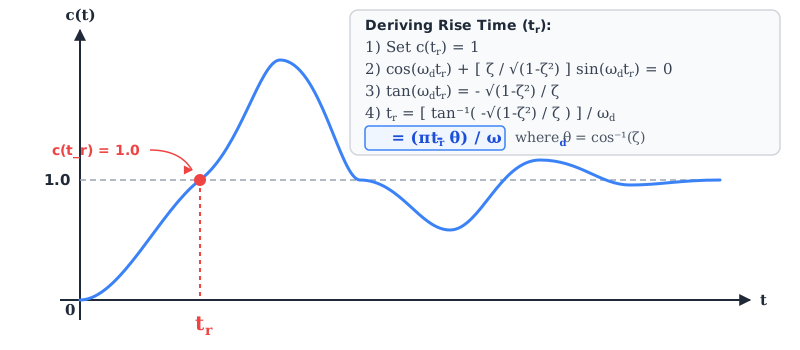
For an underdamped second-order system, the Rise Time ($t_r$) is the time required for the response to go from 0% to 100% of its final steady-state value for the very first time. Since the steady-state value is $1$, we find the rise time by setting our time-domain response $c(t)$ equal to $1$.

Course Diagram
$$c(t_r) = 1 = 1 - e^{-\zeta\omega_n t_r} \left( \cos(\omega_d t_r) + \frac{\zeta}{\sqrt{1-\zeta^2}} \sin(\omega_d t_r) \right)$$

Step 1: Algebraic Manipulation & The First Formula

Subtract $1$ from both sides. The equation equals zero. Because the negative sign and the exponential term $e^{-\zeta\omega_n t_r}$ never strictly reach zero at a finite time, we can divide them out. This leaves the trigonometric bracket itself equal to zero:

$$\cos(\omega_d t_r) + \frac{\zeta}{\sqrt{1-\zeta^2}} \sin(\omega_d t_r) = 0$$

Move the sine term to the other side:

$$\cos(\omega_d t_r) = - \frac{\zeta}{\sqrt{1-\zeta^2}} \sin(\omega_d t_r)$$

Divide both sides by $\cos(\omega_d t_r)$ and by the constant fraction to form the tangent function ($\tan = \frac{\sin}{\cos}$):

$$\frac{\sin(\omega_d t_r)}{\cos(\omega_d t_r)} = \frac{1}{-\frac{\zeta}{\sqrt{1-\zeta^2}}} \implies \tan(\omega_d t_r) = - \frac{\sqrt{1-\zeta^2}}{\zeta}$$

Taking the inverse tangent ($\tan^{-1}$), we get the direct mathematical expression for the rise time:

$$t_r = \frac{\tan^{-1}\left( - \frac{\sqrt{1-\zeta^2}}{\zeta} \right)}{\omega_d}$$

Step 2: Converting to the Standard Control Theory Form
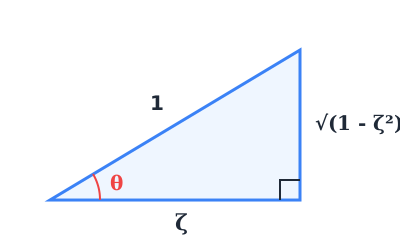
While the formula above is perfectly valid, engineers prefer a cleaner version without the negative sign. To convert it, we use the trigonometric identity for negative angles: $-\tan(\alpha) = \tan(\pi - \alpha)$. Applying this to our equation:

$$\tan(\pi - \omega_d t_r) = \frac{\sqrt{1-\zeta^2}}{\zeta}$$

Now, let's represent the damping ratio $\zeta$ as an angle $\theta$ in a right-angled triangle. If we define $\cos(\theta) = \zeta$ (meaning the Adjacent side is $\zeta$ and the Hypotenuse is $1$), the Pythagorean theorem dictates that the Opposite side is $\sqrt{1-\zeta^2}$.

Course Diagram

Looking at this triangle, the tangent of $\theta$ matches our positive fraction exactly:

$$\tan(\theta) = \frac{\text{Opposite}}{\text{Adjacent}} = \frac{\sqrt{1-\zeta^2}}{\zeta}$$

Substituting this $\tan(\theta)$ back into our equation:

$$\tan(\pi - \omega_d t_r) = \tan(\theta)$$

Step 3: The Final Rise Time Formula

By equating the angles inside the tangent functions, we get $\pi - \omega_d t_r = \theta$. A quick rearrangement gives us $\omega_d t_r = \pi - \theta$. Dividing by $\omega_d$ yields the final standard formula for Rise Time:

$$t_r = \frac{\pi - \theta}{\omega_d}$$

Where $\theta = \cos^{-1}(\zeta)$ expressed in radians.

Deep Dive: Deriving Settling Time ($t_s$)

The Settling Time ($t_s$) is the time required for the system response to enter and remain within a specified error band (usually 2% or 5%) of its final steady-state value. Since the steady-state value is $1$, this means $c(t_s)$ must stay within the range of $[0.98, 1.02]$ for the 2% criterion, or $[0.95, 1.05]$ for the 5% criterion.

Step 1: Bounding the Error

Let's rewrite the time-domain response using an alternative but mathematically equivalent trigonometric identity, where the cosine and sine terms are combined into a single shifted sine wave. The equation becomes:

$$c(t) = 1 - \frac{e^{-\zeta\omega_n t}}{\sqrt{1-\zeta^2}} \sin(\omega_d t + \theta)$$

To find the settling time for the 2% criterion, the error (the difference between $c(t)$ and $1$) must be less than or equal to $\pm 0.02$. Mathematically, this is expressed as an absolute value:

$$\left| c(t) - 1 \right| \le 0.02 \implies \left| \frac{e^{-\zeta\omega_n t}}{\sqrt{1-\zeta^2}} \sin(\omega_d t + \theta) \right| \le 0.02$$

Step 2: The "Worst-Case" Assumptions

To guarantee that our system will definitely remain inside this gap and never exit it again, we make two conservative "worst-case" assumptions:

  1. Maximum Sine Value: The sine function fluctuates between $-1$ and $1$. To find the maximum possible boundary of the error envelope, we assume the sine wave is exactly at its peak when it enters the band. Therefore, we set $|\sin(\dots)| = 1$.
  2. Small Damping Assumption: The settling time takes the longest when damping is very low ($\zeta$ approaches $0$). Under this condition, the denominator term $\sqrt{1-\zeta^2} \approx \sqrt{1-0} = 1$.

Applying these two worst-case assumptions drastically simplifies our inequality to just the exponential decay envelope:

$$e^{-\zeta\omega_n t_s} \le 0.02$$

Step 3: Logarithm and Final Formulas

To solve for $t_s$, we take the natural logarithm ($\ln$) of both sides:

$$-\zeta\omega_n t_s \le \ln(0.02)$$

We know from calculators that $\ln(0.02) \approx -3.912$.

$$-\zeta\omega_n t_s \le -3.912$$

Here is a crucial mathematical rule: when you divide or multiply an inequality by a negative number (to cancel the negatives on both sides), you must reverse the inequality sign. Therefore, solving for $t_s$ yields:

$$t_s \ge \frac{3.912}{\zeta\omega_n}$$

For engineering simplicity, we approximate $3.912$ to $4$. Similarly, repeating the exact same process for the 5% criterion ($\ln(0.05) \approx -2.99 \approx 3$) gives us the standard reference formulas:

2% Error Band
$$t_s \approx \frac{4}{\zeta\omega_n}$$
5% Error Band
$$t_s \approx \frac{3}{\zeta\omega_n}$$

5. Solved Examples

Example 1: First-Order Specs Evaluation

Find the time constant, rise time, settling time (5%), and the steady-state value of the following first-order system if it is subjected to a unit step input $R(s) = \frac{1}{s}$.

$$G(s) = \frac{5}{s+5}$$

A. Time Constant & Output Response

We can rewrite the transfer function into the standard form $\frac{1}{1+\tau s}$ by taking 5 as a common factor in the denominator:

$$G(s) = \frac{5/5}{s/5 + 1} = \frac{1}{1 + 0.2s}$$

From this, we identify the time constant $\tau = \frac{1}{5} = 0.2$ s.

Since we are providing a unit step input, the time-domain response $c(t)$ follows the standard exponential charge curve $c(t) = 1 - e^{-t/\tau}$:

$$c(t) = 1 - e^{-5t}$$

B. Steady-State Value (Calculated 2 Ways)

We can calculate the final steady-state value using both the Time Domain and the S-Domain formulas:

  • Using Time Domain: Take the limit of $c(t)$ as $t \to \infty$:

    $$c(\infty) = 1 - e^{-5(\infty)} = 1 - 0 = \mathbf{1}$$
  • Using S-Domain (Final Value Theorem): Take the limit of $s \cdot C(s)$ as $s \to 0$:

    $$c(\infty) = \lim_{s \to 0} s \cdot \left( \frac{1}{s} \cdot \frac{5}{s+5} \right) = \frac{5}{0+5} = \mathbf{1}$$

C. Rise Time ($t_r$)

The rise time is the time taken to go from 10% to 90% of the steady-state value (which is 1). We solve the output equation for these two time targets:

At 90% ($t_2$): $0.9 = 1 - e^{-5t_2} \implies e^{-5t_2} = 0.1 \implies t_2 = 0.46 \text{ s}$

At 10% ($t_1$): $0.1 = 1 - e^{-5t_1} \implies e^{-5t_1} = 0.9 \implies t_1 = 0.021 \text{ s}$

$$t_r = t_2 - t_1 = 0.46 - 0.021 = \mathbf{0.44 \text{ s}}$$

Verification: Our standard shortcut formula $t_r \approx 2.2\tau$ yields $2.2 \times 0.2 = 0.44$ s, which perfectly matches our exact algebraic calculation!

D. Settling Time (5%)

The time required to enter and remain within a 5% band of the final value (reaching 0.95). We set the output equation equal to 0.95:

$$0.95 = 1 - e^{-5t_s} \implies e^{-5t_s} = 0.05 \implies \mathbf{t_s = 0.6 \text{ s}}$$

Verification: The shortcut formula $t_s(5\%) \approx 3\tau$ yields $3 \times 0.2 = 0.6$ s, again a perfect match.

Example 2: First-Order with Scaled Inputs

Consider the system $G(s) = \frac{6}{s+6}$. Find the output response, settling time (5%), and steady-state value if the system is subjected to two different inputs: a scaled step $R(t) = 10u(t)$ and a scaled ramp $R(t) = 8t$.

A. Identify the Time Constant

We rewrite the transfer function into the standard form $\frac{1}{1+\tau s}$ by taking 6 as a common factor in the denominator:

$$G(s) = \frac{6}{s+6} = \frac{6/6}{s/6 + 1} = \frac{1}{1 + \frac{1}{6}s}$$

So, the time constant is $\tau = \frac{1}{6}$ s.

B. Case 1: Scaled Step Input $R(t) = 10u(t)$

In the S-Domain, $R(s) = \frac{10}{s}$. Remember that we can pull a constant (gain) out of a Laplace transform. The response to a unit step is $1 - e^{-t/\tau}$. We simply multiply it by the amplitude $A=10$:

$$Y(t) = 10 \left( 1 - e^{-t/\tau} \right) = \mathbf{10 - 10e^{-6t}}$$

Steady-State Value: $Y(\infty) = 10 - 10e^{-\infty} = \mathbf{10}$.

Settling Time (5%): We set the output to 95% of the final value ($0.95 \times 10 = 9.5$):

$$9.5 = 10 - 10e^{-6t_s} \implies \mathbf{t_s = 0.5 \text{ s}}$$

C. Case 2: Scaled Ramp Input $R(t) = 8t$

In the S-Domain, $R(s) = \frac{8}{s^2}$. Similarly, the standard unit ramp response is $-\tau + t + \tau e^{-t/\tau}$. We multiply this by the amplitude $A=8$:

$$Y(t) = 8 \left( -\tau + t + \tau e^{-t/\tau} \right) = \mathbf{8 \left( -\frac{1}{6} + t + \frac{1}{6}e^{-6t} \right)}$$

Steady-State Value: $Y(\infty) = \mathbf{\infty}$.

Settling Time: Because the final value is $\infty$, the concept of a settling time is mathematically undefined.

Because we don't know when are we going to reach infinity.

Example 3: Second-Order Response Evaluation

A second-order system has $\zeta = 0.6$ and $\omega_n = 5 \text{ rad/s}$. Find the rise time, peak time, maximum overshoot, and 5% settling time for a unit step input.

Damped Frequency ($\omega_d$)

$$\omega_d = \omega_n\sqrt{1-\zeta^2} = 5\sqrt{1-0.6^2} = 4 \text{ rad/s}$$

Rise Time ($t_r$)

$$\theta = \cos^{-1}(0.6) = 0.927 \text{ rad}$$
$$t_r = \frac{\pi - \theta}{\omega_d} = \frac{3.14 - 0.927}{4} = 0.55 \text{ sec}$$

Peak Time ($t_p$)

$$t_p = \frac{\pi}{\omega_d} = \frac{3.14}{4} = 0.785 \text{ sec}$$

Maximum Overshoot ($\%M_p$)

$$\%M_p = e^{-\left(\frac{0.6\pi}{\sqrt{1-0.6^2}}\right)} \times 100 = 9.5\%$$

Settling Time ($t_s$ at 5%)

$$t_s (5\%) = \frac{3}{\zeta\omega_n} = \frac{3}{0.6 \times 5} = 1 \text{ sec}$$

Example 4: Closed-Loop Second-Order System
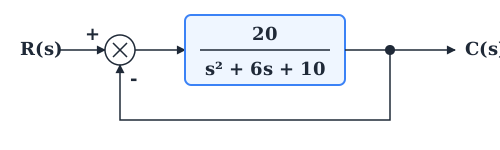
Consider a closed-loop system with forward path $G(s) = \frac{20}{s^2+6s+10}$ and unity negative feedback $H(s)=1$. Find the characteristic equation, closed-loop poles, $\omega_n$, $\zeta$, $\omega_d$, peak time ($t_p$), 5% settling time ($t_s$), and the time-domain output $c(t)$ for a unit step input.

Course Diagram

1. Overall Transfer Function & Characteristic Eq.

$$T(s) = \frac{G(s)}{1+G(s)H(s)} = \frac{\frac{20}{s^2+6s+10}}{1 + \frac{20}{s^2+6s+10}} = \frac{20}{s^2+6s+30}$$

The characteristic equation is the denominator equated to zero: $s^2 + 6s + 30 = 0$.

2. Parameters ($\omega_n$, $\zeta$, $\omega_d$)

By comparing $s^2 + 6s + 30$ to the standard form $s^2 + 2\zeta\omega_n s + \omega_n^2$:

$$\omega_n^2 = 30 \implies \omega_n = \sqrt{30} \approx 5.47 \text{ rad/s}$$
$$2\zeta\omega_n = 6 \implies \zeta = \frac{6}{2\sqrt{30}} = \frac{3}{\sqrt{30}} \approx 0.547$$

Since $\zeta < 1$, the system is underdamped. We compute the damped natural frequency $\omega_d$:

$$\omega_d = \omega_n\sqrt{1-\zeta^2} = \sqrt{30}\sqrt{1 - \left(\frac{3}{\sqrt{30}}\right)^2} = \sqrt{30 - 9} = \sqrt{21} \approx 4.58 \text{ rad/s}$$

3. Closed-Loop Poles

The poles are the roots of the characteristic equation, given by $-\zeta\omega_n \pm j\omega_d$:

$$s_{1,2} = -3 \pm j\sqrt{21} \approx -3 \pm j4.58$$

4. Time Specifications

Peak Time ($t_p$)

$$t_p = \frac{\pi}{\omega_d} = \frac{3.14}{\sqrt{21}} \approx 0.685 \text{ sec}$$

Settling Time ($t_s$ at 5%)

$$t_s = \frac{3}{\zeta\omega_n} = \frac{3}{3} = 1 \text{ sec}$$

5. Output Response c(t) for Unit Step

For a unit step input $R(s) = \frac{1}{s}$, the output is $C(s) = \frac{1}{s} \cdot \frac{20}{s^2 + 6s + 30}$.

Mathematical Shortcut (Avoiding Partial Fractions)

Instead of doing a long partial fraction expansion from scratch for the numerator $20$, we can force the transfer function into the standard form where the numerator exactly matches $\omega_n^2 = 30$. We extract a gain factor to mathematically balance it:

Course Diagram
$$C(s) = \frac{1}{s} \cdot \left[ \mathbf{\frac{2}{3}} \cdot \frac{30}{s^2 + 6s + 30} \right] = \mathbf{\frac{2}{3}} \left( \frac{1}{s} \cdot \frac{\omega_n^2}{s^2 + 2\zeta\omega_n s + \omega_n^2} \right)$$

Because we already know the exact time-domain solution for the standard part, we simply multiply that standard solution by the constant gain $\frac{2}{3}$!

Applying the standard underdamped inverse Laplace transform and multiplying by $\frac{2}{3}$:

$$c(t) = \frac{2}{3} \left[ 1 - e^{-\zeta\omega_n t} \left( \cos(\omega_d t) + \frac{\zeta}{\sqrt{1-\zeta^2}} \sin(\omega_d t) \right) \right]$$

Substituting our calculated values:

  • $\zeta\omega_n = 3$
  • $\omega_d = \sqrt{21} \approx 4.58$
  • $\frac{\zeta}{\sqrt{1-\zeta^2}} = \frac{0.547}{\sqrt{1 - 0.547^2}} = \frac{3}{\sqrt{21}} \approx 0.655$
$$c(t) = \frac{2}{3} \left[ 1 - e^{-3t} \left( \cos(4.58t) + 0.655 \sin(4.58t) \right) \right]$$

Example 5: System Identification from Response Curve
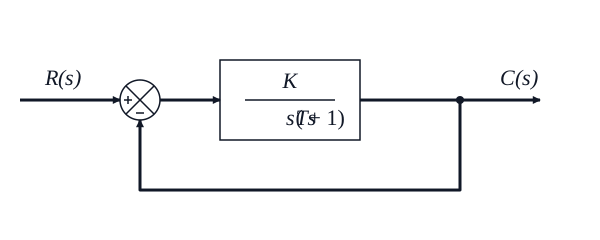
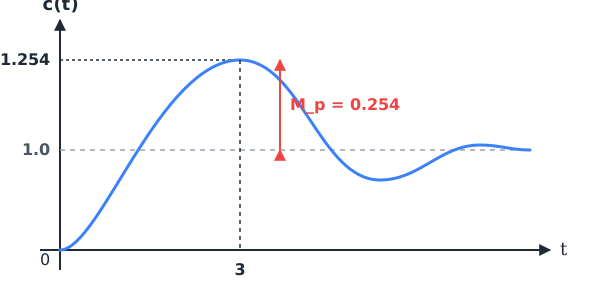
When the closed-loop system shown below is subjected to a unit step input, the output response curve displays a Maximum Overshoot of $0.254$ (25.4%) occurring at a Peak Time of $t_p = 3 \text{ sec}$. Determine the exact values of the system parameters $K$ and $T$.

Course Diagram
Course Diagram

1. Find Overall T.F to identify $\omega_n$ and $\zeta$

First, we compute the closed-loop transfer function $H(s) = \frac{G}{1+G}$:

$$H(s) = \frac{\frac{K}{Ts^2+s}}{1 + \frac{K}{Ts^2+s}} = \frac{K}{Ts^2 + s + K}$$

To match the standard second-order format ($s^2 + 2\zeta\omega_n s + \omega_n^2$), the coefficient of $s^2$ must be 1. We divide the numerator and denominator by $T$:

$$H(s) = \frac{K/T}{s^2 + \frac{1}{T}s + \frac{K}{T}}$$
$$\omega_n^2 = \frac{K}{T}$$
$$2\zeta\omega_n = \frac{1}{T}$$

2. Extract Damping Ratio ($\zeta$) from Overshoot

We know the Maximum Overshoot is $M_p = 0.254$. Using the exact exponential equation:

$$0.254 = e^{-\frac{\zeta\pi}{\sqrt{1-\zeta^2}}}$$

Take the natural logarithm ($\ln$) of both sides to cancel the exponential, then solve for $\zeta$:

$$\ln(0.254) = -\frac{\zeta\pi}{\sqrt{1-\zeta^2}} \implies -1.37 = -\frac{\zeta\pi}{\sqrt{1-\zeta^2}} \implies \mathbf{\zeta \approx 0.4}$$

3. Extract Frequencies from Peak Time ($t_p$)

We know $t_p = 3 \text{ sec}$. We can find the damped natural frequency $\omega_d$:

$$t_p = \frac{\pi}{\omega_d} = 3 \implies \omega_d = \frac{\pi}{3} = 1.047 \text{ rad/s}$$

Now, substitute $\omega_d$ and $\zeta$ into the definition of damped frequency to find $\omega_n$:

$$\omega_d = \omega_n\sqrt{1-\zeta^2} \implies 1.047 = \omega_n\sqrt{1-0.4^2}$$
$$\omega_n = \frac{1.047}{\sqrt{0.84}} = \mathbf{1.14 \text{ rad/s}}$$

4. Calculate Final Parameters ($K$ and $T$)

Now we simply substitute $\zeta = 0.4$ and $\omega_n = 1.14$ back into the comparison equations from Step 1:

Finding T:

$$\frac{1}{T} = 2\zeta\omega_n = 2(0.4)(1.14) = 0.912 \implies \mathbf{T = \frac{1}{0.912} = 1.096 \text{ sec}}$$

Finding K:

$$\frac{K}{T} = \omega_n^2 \implies K = T \cdot \omega_n^2 = 1.096 \cdot (1.14)^2 \implies \mathbf{K = 1.424}$$